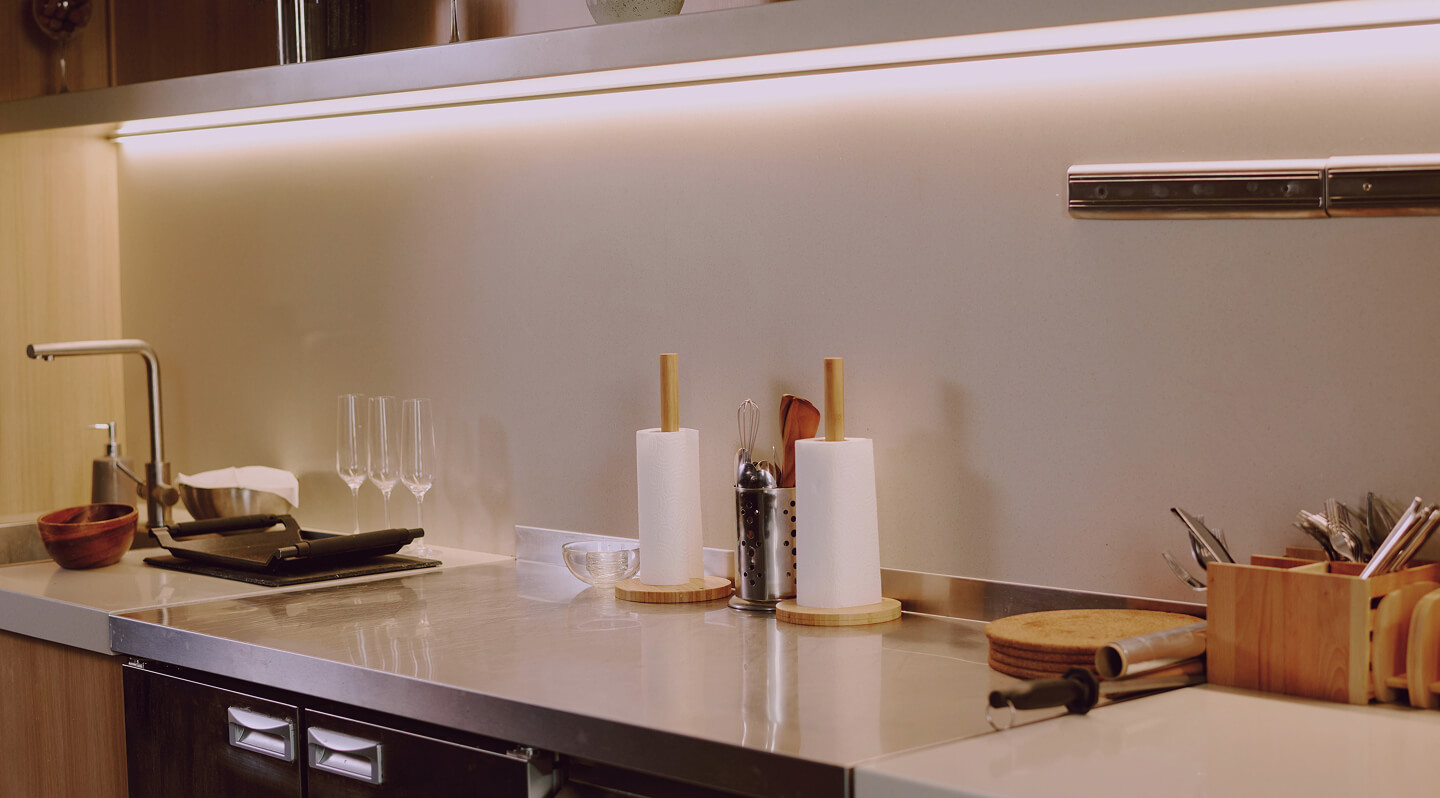
How do I choose the right lighting for my home?
Start with the function of the space. What activities happen there, at what times of day, and how much natural light enters the room. From there, colour temperature, lumen output, and fixture placement follow logically. Our consultation process walks you through every factor. We do not hand you a catalog and leave you to figure it out.
What are the different types of lighting for residential applications?
Residential lighting falls into three categories: ambient, task, and accent. Ambient lighting provides general illumination for a room. Task lighting puts light precisely where work happens, countertops, desks, reading surfaces, staircases. Accent lighting draws attention to what is worth noticing, a textured wall, a staircase, an architectural detail. A well-designed home uses all three intentionally. Most big box solutions address only one.
What is the best colour temperature for residential lighting?
Colour temperature is ultimately a personal choice that needs to provide comfort. For living spaces and bedrooms, 2700K to 3000K delivers warm, comfortable illumination suited to evenings and relaxation. For kitchens and bathrooms where accuracy matters, 3500K to 4000K provides a cooler light that is more suitable for the tasks performed. Diana Lighting specifies colour temperature by room, function and our clients' personal preferences, not by what is available in a standard pack.
Are LED lights compatible with dimmers?
Most LED fixtures are compatible with dimmers, but dimmer compatibility must be verified before installation. Not all dimmers are rated for LED loads and mismatched combinations cause flickering, buzzing, or premature failure. Diana Lighting's lighting systems come with fully compatible components and are always tested before delivery to ensure proper functioning that is free of defects.
Are LED lights safe for home use?
Yes. LED lighting produces significantly less heat than incandescent or halogen sources, reducing burn and fire risk. Unlike compact fluorescent lamps, LEDs contain no mercury and require no special disposal. For stair and outdoor applications, low-voltage LED systems provide an additional layer of safety.
Can lighting increase the temperature inside my home?
Traditional incandescent and halogen fixtures convert a large portion of their energy draw into heat, which raises room temperature measurably over time. LED fixtures operate at a fraction of that thermal output. In summer months, switching to LED lighting reduces cooling loads and contributes to lower energy bills beyond just the lighting itself.
How do I reduce glare from my lighting?
Glare is a specification problem, not just a comfort issue. It results from fixtures that are too bright for the application, positioned incorrectly, or lacking adequate diffusion. Diana Lighting designs fixtures with diffused lenses and positions them to eliminate direct lines of sight to the light source. Our stair lighting systems in particular are specified for uniform distribution with zero discomfort glare.
Should light fixtures match throughout my home?
Not necessarily. Fixtures should be consistent in finish and visual weight within a single room or open-plan space. Across different rooms, what matters more is that colour temperature is consistent and that each fixture is appropriate for its specific function. Matching fixtures for the sake of matching, regardless of what the room needs, is a retail mindset, not a design one.
How long do residential LED fixtures last?
Quality LED fixtures are rated for 25,000 to 50,000 hours. At average residential use, that translates to 15 to 25 years before replacement is necessary. Diana Lighting backs every product with competitive warranties and specifies materials for long-term performance, not just initial cost.
Can you help with a custom lighting design for my home or rental?
Yes. Custom design is our standard process, not an add-on. We work with homeowners and tenants across Canada from initial consultation through to installation coordination, including working directly with millwork fabricators, electricians, and stair manufacturers where the project requires it. Contact us to get started.